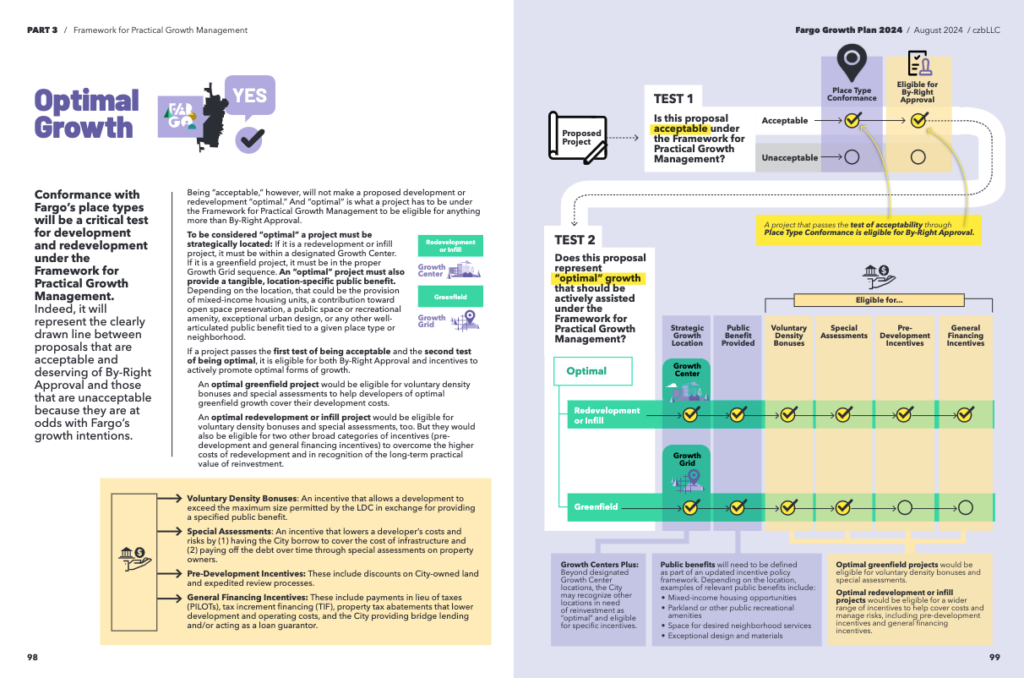
CZB led a team of engineers, fiscal impact analysts, and coding experts, working alongside a technical committee of staff from City Hall and partner agencies and an Advisory Committee of community stakeholders. The result was a Framework for Practical Growth Management, built around four growth models: an urban-rural transect, a system of place types, a growth grid to organize future peripheral development, and an emphasis on absorbing future growth within designated mixed-use growth centers. To align the framework with Fargo’s practical, permission-oriented culture, the plan introduced By-Right Approval, which gives streamlined administrative approval to projects that clearly align with the growth models, and Optimal Growth, which reserves incentives for By-Right-eligible projects that go further by locating in a strategic geography and providing a public benefit. CZB also designed the project’s scope from the outset to transition smoothly into a code development process, directly addressing a shortcoming Fargo had lived through before: its 2007 growth plan and 2013 comprehensive plan had both sat for years without an updated code to implement them.
Fargo’s new Growth Plan was adopted in 2024, giving the city a clear, culturally grounded framework for where and how it grows, and what kind of development it wants to encourage. Because the plan’s scope was built for a smooth handoff into implementation, it shaved months, if not years, off the typical delay between plan adoption and code implementation, setting up CZB’s next engagement with the city: the Fargo Land Development Code project, which began that same December.